· The Second Design · Real World Ready · 5 min read
What Happened When We Helped 200+ Students Prepare for FOSS Hack 2025
FOSS United asked us to improve project quality at their hackathon. Here's what we learned about helping students figure out what to build.
In December 2024, we got a call from FOSS United. They had a problem.
Every year, they run FOSS Hack, one of India’s largest open-source hackathons. And every year, they noticed the same pattern: students would show up on the morning of the hackathon asking, “What should I build?”
Even among students who did build something, many would submit projects with poor README files, no demo videos, and sometimes without proper open-source licenses. The code might be solid, but everything around it would let them down.
They asked us: Can you help improve the quality of projects coming out of FOSS Hack 2025?
This became one of our Real World Ready collaborations. Here’s what we did, what we learned, and what it might mean for organisations thinking about working with us.
The Real Problem: Agency Doesn’t Transfer Automatically
When we started talking to the FOSS United team, we kept hearing variations of the same insight. Students who registered for a hackathon were clearly motivated. They had enough agency to learn to code, to find out about FOSS Hack, to actually sign up. That’s not nothing.
But here’s what we realised: agency varies across domains.
A student who shows tremendous initiative when learning a new programming language might freeze when asked to decide what problem to solve. Someone who writes clean, elegant code might produce a README that nobody can understand. The agency required to collaborate with a team, reach out to a mentor, or pitch your project is different from the agency shown while debugging at 2am.
This became our core premise. We weren’t going to teach these students to code. They already knew how. We were going to help them exercise agency in the areas where they were stuck: deciding what to build, and communicating what they’d built.
What We Actually Did
We designed a 90-minute interactive session that ran five times in the lead-up to the hackathon. Each session focused on two things:
1. What to Build
We walked students through a systematic way to identify problems worth solving. Not by giving them a list of project ideas, but by helping them think through their own interests, map those to real-world needs, and scope something achievable in a weekend.
2. How to Showcase Your Project
We showed them what good READMEs look like. We showed them what bad ones look like. We had them draft their own README before writing a single line of code, because if you can’t explain what you’re building and why, you probably haven’t thought it through.
Every session had a workbook. Students would work through activities, then discuss with us. We’d give feedback, they’d iterate. The format was deliberately not a lecture. We wanted them doing things, not just listening.
The Numbers
Across all five sessions:
- 605 registrations
- 217 participants who showed up and stayed
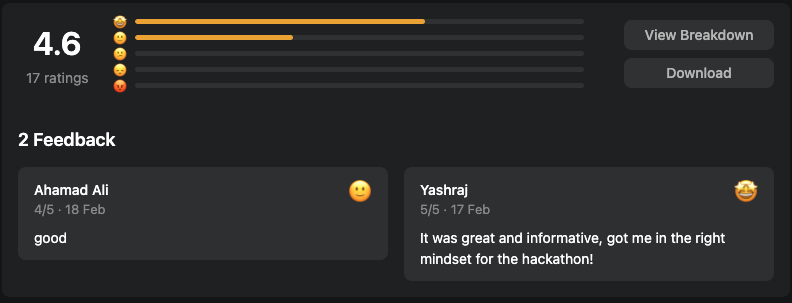
- 4.5 out of 5 average rating
What Participants Said
Here’s some of the feedback we received:
“It was great, got better understanding on how to prepare and plan for attending a hackathon.”
“It was great and informative, got me in the right mindset for the hackathon!”
“It was great, nice to have a session with those people.”
The common thread? Participants felt more prepared. They had clarity they didn’t have before. And crucially, they had something concrete to work with going into the hackathon.
What FOSS United Said
Rahul Poruri, CEO of FOSS United, recorded his thoughts on the collaboration. It’s worth watching:
The short version: they felt we did our homework, understood their community, and built something that gave them new language for working with students.
FOSS United also wrote about this collaboration on their blog. You can read their full account here.
The Bigger Picture
This wasn’t just about one hackathon. The skills we focused on, figuring out what problem to solve, scoping it realistically, communicating clearly about what you’ve built, these are skills students will use throughout their careers.
That’s what Real World Ready is about. We partner with organisations like FOSS United, who have a community and a context, and we design interventions that help young people develop agency in areas where they’re typically stuck.
We created a 21-step framework for hackathon participation that maps the entire journey from awareness to post-event. We didn’t implement all 21 steps for FOSS Hack 2025, but the framework now exists for future iterations. That’s how we think about these collaborations: build something that can be refined and reused.
What This Means If You’re Considering Working With Us
If you’re running a program for students, whether it’s a hackathon, a fellowship, a campus initiative, or something else entirely, and you’re noticing that participants struggle with certain aspects that aren’t about technical skill, we might be able to help.
We don’t show up with a pre-packaged curriculum. We start by understanding your context: who your learners are, where they get stuck, what outcomes you’re trying to achieve. Then we design something specific to that.
For FOSS United, the intervention was pre-hackathon sessions. For another partner, it might be a multi-week program, or a series of workshops, or something else entirely.
The common thread is this: we help organisations design learning experiences that move young people from passive to active, from stuck to moving, from consuming to creating.
Interested in exploring a Real World Ready collaboration? Get in touch and tell us about your learners and what you’re trying to achieve.